An electric arc furnace melts scrap steel by striking an arc between graphite electrodes and the charge, each electrode raised and lowered by a hydraulic column that holds the arc at the right length. When an electrode breaks — cracks off partway down its column — part of that arc is lost instantly, and SMS Group wanted it caught by the same monitoring system that already logs every furnace's sensors, not left for someone to notice on a shift log later. This thesis, carried out on-site at SMS using the company's internal software for data handling, was writing and validating a MATLAB-based algorithm that flags a break from signals SMS already instruments on every furnace it builds — so the detector drops onto an existing signal path with no new hardware. Some results below are described qualitatively rather than with exact figures, in line with the client's data confidentiality; the thesis itself was written and submitted in Italian.
The problem
A break looks like noise until it doesn't
A genuine electrode break and an ordinary process transient look alike for a fraction of a second — the furnace's secondary voltage and current already swing constantly as scrap collapses and arcs restrike, and the hydraulic position-control loop is reacting the whole time. Reviewing past breakage events from SMS's own service records surfaced what actually tells the two apart: not a dip on any single trace, but how the three channels respond together — and on different timescales — when conductive material is really gone.
The signature of a break
Three traces, one moment
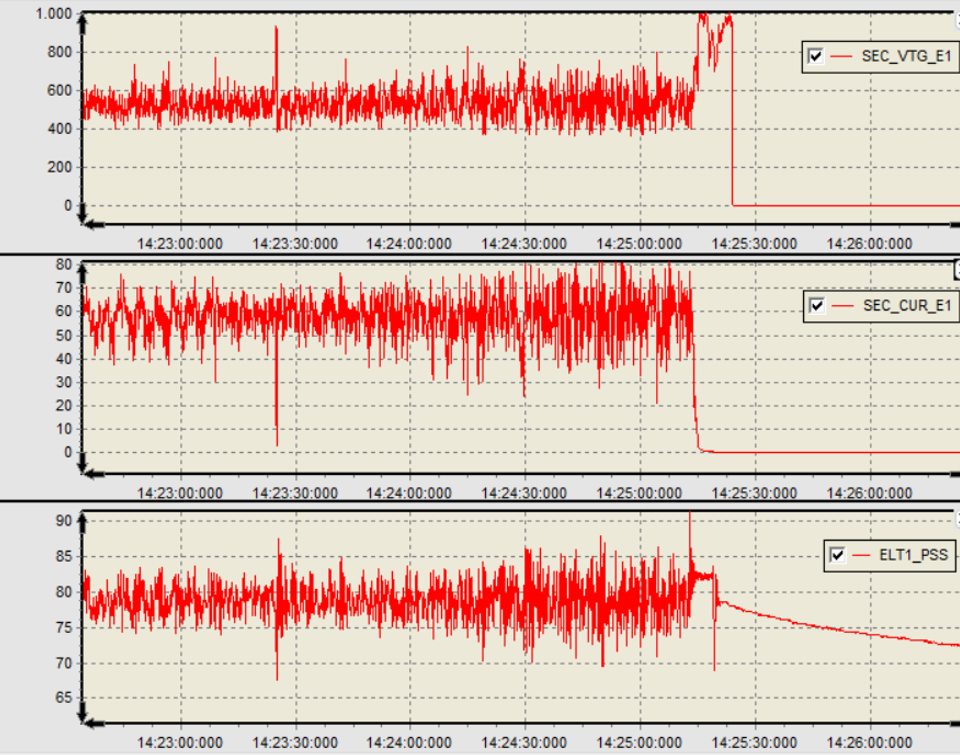
The figure below is a real capture from SMS's own signal-logging software, at the moment of an actual electrode break on a client furnace. Secondary voltage and secondary current collapse to zero in the same single time step — no arc, no current — while the electrode's hydraulic pressure doesn't cliff the same way: it bends into a slow decay over the following minute, as the position-control loop stops fighting for an arc that's no longer there. Two channels answer instantly, the third answers late and gradually — and telling a real break from a routine dip means reading all three against each other, not any one of them alone.
How it decides
Two fast channels, one slow one
Because the three channels don't fail the same way, they can't share one detection rule. Voltage and current are checked with a level crossing — a hard drop past a relative threshold, held for a short window to reject the single-sample spikes already visible in the noise above. Pressure is checked with a slope condition instead — a sustained negative trend rather than a level — since by the time it fell far enough to trip a level threshold, a level-based detector would already be tens of seconds late. A break is only flagged once both conditions agree, which is what keeps an ordinary arc restrike (fast on voltage and current, flat on pressure) from tripping a false alarm. The rule set was tuned and validated against a set of confirmed past breakage events pulled from SMS's furnace logs across multiple client sites, then handed back to SMS for integration into their monitoring software. Exact detection-window and false-positive figures belong to the client and aren't published here.